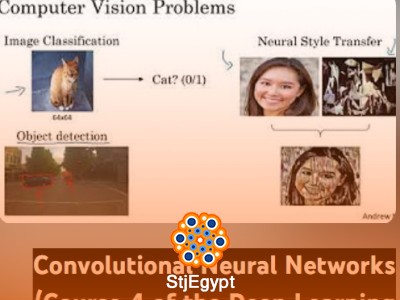

This course provides a structured introduction to convolutional neural networks (CNNs) and computer vision as part of a deep learning specialization. It explains how computers interpret and process images using mathematical operations and layered neural network architectures.
The course begins with the fundamentals of computer vision, explaining how images are represented in a format that machines can understand. It then introduces edge detection techniques, which help identify important features in images such as boundaries and shapes.
Next, the course explores convolution operations in detail, including padding, strides, and filters. These concepts are essential for understanding how CNNs extract features from images while preserving spatial information.
Learners are then introduced to convolutional layers and how they form the building blocks of CNN architectures. Pooling layers are also covered, showing how they reduce the size of feature maps while retaining important information.
The course continues with practical examples of simple CNN models and explains how multiple layers work together to recognize patterns. It also discusses why convolutions are more efficient than fully connected networks for image data.
Finally, the course introduces classic neural network architectures and explains why studying case studies is important for understanding real-world computer vision applications.
By the end, learners gain a strong foundation in CNNs and computer vision, preparing them for advanced topics such as object detection, image recognition, and modern deep learning models.