Deep Dive into LLMs like ChatGPT
عدد الدروس : 1 عدد ساعات الدورة : 03:31:24 شهادة معتمدة : نعم التسجيل في الدورة للحصول على شهادةللحصول على شهادة
- 1- التسجيل
- 2- مشاهدة الكورس كاملا
- 3- متابعة نسبة اكتمال الكورس تدريجيا
- 4- بعد الانتهاء تظهر الشهادة في الملف الشخصي الخاص بك
قائمة الدروس
عن الدورة
This course provides a technical deep dive into Large Language Models (LLMs) such as ChatGPT, focusing on how they are built, trained, and deployed in real-world applications.
The course begins by explaining the core idea behind LLMs: predicting the next token in a sequence. This simple objective, when scaled across massive datasets and model sizes, leads to highly capable systems that can generate coherent and context-aware text.
A key component covered is the transformer architecture, which powers modern LLMs. The course explains how self-attention mechanisms allow models to weigh relationships between words in a sequence, enabling better understanding of context compared to older neural network designs.
Learners then explore tokenization, which breaks text into smaller units (tokens) that models can process efficiently. This includes subword methods that help handle rare words and improve generalization.
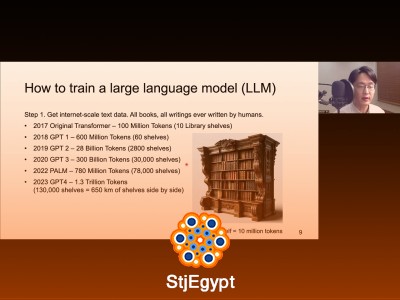
The training pipeline is also covered in detail, including pretraining on large-scale text datasets using unsupervised learning and optimization techniques such as gradient descent. The course explains how compute, data, and model size interact to determine performance.
Another important topic is fine-tuning, where pretrained models are adapted to specific tasks or domains using labeled data. This step is essential for turning general-purpose models into specialized assistants like ChatGPT.
The course also introduces inference and deployment concepts, showing how models generate responses in real time and how they are optimized for spee