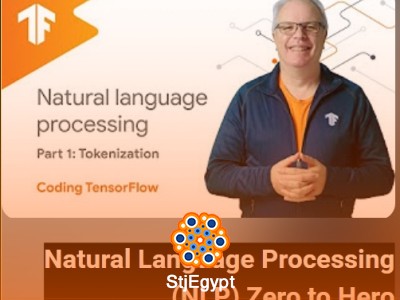

NLP Zero to Hero: Natural Language Processing with Deep Learning
Introduction to Natural Language Processing (NLP) and AI Text Understanding
This NLP Zero to Hero course introduces the fundamental concepts of Natural Language Processing (NLP) and demonstrates how deep learning techniques can be used to understand and generate human language. It is designed for beginners who want to learn how modern AI systems process text data.
What is Natural Language Processing (NLP)
Natural Language Processing is a branch of artificial intelligence that focuses on enabling machines to understand, interpret, and generate human language. It powers applications like chatbots, translation systems, sentiment analysis, and voice assistants.
Why NLP is Important in Modern AI Systems
NLP is one of the fastest-growing areas in AI because most real-world data exists in text form. From social media posts to business reviews and emails, NLP helps transform unstructured text into meaningful insights that can be used for decision-making and automation.
Text Preprocessing and Data Preparation Techniques
The course starts with tokenization, one of the most important NLP preprocessing techniques. You will learn how text is broken into tokens and transformed into a format that machine learning models can understand. It then covers sequencing, where sentences are converted into numerical representations suitable for neural network training.
Tokenization and Text Splitting
Learners will understand how sentences are broken into words or subwords (tokens), which is the first step in preparing text data for machine learning models.
Text to Numerical Representation (Sequencing)
This section explains how words are converted into numbers so that neural networks can process them efficiently. Techniques like word indexing and padding are also introduced.
Text Cleaning and Preprocessing Steps
Students will also learn how to clean text data by removing noise such as punctuation, stop words, and irrelevant symbols to improve model accuracy.
Sentiment Analysis and Text Classification
As the course progresses, you will build a sentiment analysis model capable of identifying positive and negative emotions within text data. This provides hands-on experience with one of the most common NLP applications used in business and social media analytics.
Building a Sentiment Analysis Model
Learners will train a deep learning model that can classify text based on emotional tone, helping businesses understand customer feedback and public opinion.
Real-World Applications of Text Classification
Sentiment analysis is widely used in marketing, brand monitoring, product reviews, and social media analysis, making it one of the most practical NLP applications.
Model Evaluation for Text Data
Students will learn how to evaluate NLP models using accuracy metrics and validation techniques to ensure reliable predictions.
Recurrent Neural Networks for Sequential Data
The course also introduces Recurrent Neural Networks (RNNs), which are designed to process sequential data such as text. You will learn how Long Short-Term Memory (LSTM) networks improve the ability of models to capture long-range dependencies within language.
Understanding RNN Architecture
Recurrent Neural Networks are designed to remember previous inputs, making them ideal for processing sentences and sequences where context matters.
LSTM Networks and Long-Term Memory
LSTM networks solve the limitations of standard RNNs by retaining important information over long sequences, improving performance in complex language tasks.
Sequence Learning in NLP Models
Learners will understand how models process text step by step, maintaining context across words to generate more accurate predictions.
AI Text Generation and Creative NLP Applications
In the final project, you will train an AI model to generate poetry, demonstrating how neural networks can create human-like text. By the end of the course, you will understand key NLP concepts and how deep learning powers modern language applications.
Text Generation with Deep Learning
Students will build models capable of generating new text based on learned patterns from training data.
Poetry Generation Project
The final project demonstrates creative AI capabilities by generating poetry, showing how machines can learn language structure and style.
Applications of Generative NLP Models
Generative models are used in chatbots, content creation, storytelling systems, and AI writing assistants.
Who This Course Is For
This course is ideal for beginners who want to learn how modern AI systems process text data, including students, developers, data scientists, and anyone interested in Natural Language Processing and deep learning.