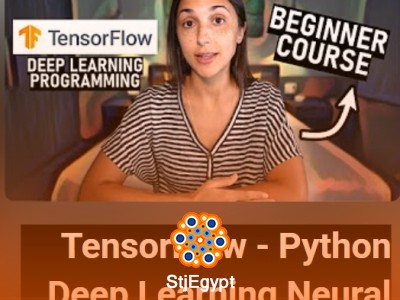

TensorFlow and Keras Deep Learning Master Course
Introduction to Deep Learning and Neural Networks
This comprehensive TensorFlow and Keras course is designed for learners who want to master deep learning and neural network development. The course starts with the fundamentals of neural networks and the prerequisites required to understand deep learning concepts. Students will learn how to set up TensorFlow and Keras with GPU support, process and prepare datasets, and build artificial neural networks using Keras APIs.
Understanding Deep Learning and Why It Matters
Deep learning has become the backbone of modern artificial intelligence systems, powering applications such as image recognition, speech processing, recommendation systems, and autonomous technologies. In this section, learners understand how neural networks mimic human learning by adjusting weights based on data patterns.
Neural Network Building Blocks Explained
Students will explore the core components of neural networks, including input layers, hidden layers, activation functions, and output layers. Each concept is explained in a practical way to help learners understand how data flows through a model and how predictions are generated.
Setting Up TensorFlow and Keras with GPU Support
The course explains how to properly install TensorFlow and Keras, configure GPU acceleration, and set up an optimized development environment. This ensures faster model training and efficient handling of large datasets during deep learning projects.
Data Processing and Machine Learning Workflows
Students will learn how to process and prepare datasets, build complete machine learning pipelines, and understand how data moves from raw input to trained models. The course focuses on real-world workflows used in AI development.
Data Loading and Preprocessing Techniques
Learners will understand how to load datasets from different sources, clean data, handle missing values, normalize inputs, and prepare structured datasets suitable for training deep learning models.
Feature Engineering and Data Transformation
This section introduces feature scaling, encoding techniques, and data transformation methods that improve model accuracy and performance. Students learn how small changes in data preparation can significantly impact results.
Building End-to-End Machine Learning Pipelines
The course guides learners through complete workflows starting from dataset preparation, moving to model training, and ending with evaluation and prediction generation, simulating real industry projects.
Model Training, Evaluation, and Optimization
The course covers model training, validation techniques, prediction generation, confusion matrix evaluation, and model saving and loading. Learners will gain practical experience working with real-world machine learning workflows.
Training Neural Networks Step by Step
Students will learn how to compile models, choose optimizers, define loss functions, and train neural networks using structured training loops. The focus is on understanding how models improve over time.
Validation Techniques and Overfitting Control
This section explains how validation datasets are used to monitor model performance and prevent overfitting. Learners also explore techniques like early stopping and dropout layers.
Model Evaluation and Confusion Matrix Analysis
Students will learn how to evaluate classification models using accuracy metrics and confusion matrices, helping them understand where models perform well and where improvements are needed.
Saving, Loading, and Reusing Models
The course teaches how to save trained models and reload them for predictions or deployment, making it easier to integrate AI models into real-world applications.
Convolutional Neural Networks (CNNs) for Computer Vision
In addition, the course introduces Convolutional Neural Networks (CNNs), one of the most important architectures in computer vision. Students will learn image preprocessing techniques, CNN architecture design, training procedures, and image classification predictions.
How CNNs Work in Image Recognition
Learners will understand how convolutional layers detect patterns such as edges, shapes, and textures, allowing AI systems to interpret images effectively.
Image Preprocessing and Data Augmentation
This section covers resizing, normalization, flipping, rotation, and other augmentation techniques that improve model generalization and performance.
CNN Model Architecture Design
Students will explore how convolutional layers, pooling layers, and dense layers work together to build powerful image classification models.
Real-World Image Classification Projects
The course demonstrates how CNN models are used in practical applications such as medical imaging, object detection, and facial recognition systems.
Advanced Deep Learning Concepts
The course also introduces advanced topics to prepare learners for real-world AI development and research-level understanding.
Transfer Learning with Pretrained Models
Learners will understand how to use pretrained models like VGG, ResNet, and EfficientNet to build powerful systems without training from scratch.
Hyperparameter Tuning and Model Improvement
This section explains how adjusting learning rates, batch sizes, and network depth can significantly improve model performance.
Deployment of Deep Learning Models
Students will also gain a basic understanding of deploying models into real applications such as web apps, mobile apps, or cloud-based systems.
Who This Course Is For
This course is ideal for aspiring AI engineers, machine learning practitioners, data scientists, and developers seeking hands-on experience with modern deep learning frameworks.
It is also suitable for beginners who want to start a career in artificial intelligence, as well as professionals looking to strengthen their understanding of TensorFlow and Keras.