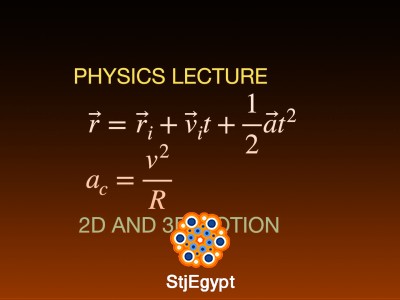

This physics mechanics course introduces the fundamental principles that explain how objects move and interact with forces. It is designed for students who want a clear understanding of classical mechanics and the mathematical tools used to analyze motion.
The course begins with vectors in multiple dimensions, an essential concept in physics used to describe quantities such as displacement, velocity, and force. Students learn how to represent vectors, break them into components, and apply them in problem solving.
Next, the course explores Newton’s Laws of Motion, the three fundamental laws that describe how forces affect the movement of objects. Learners understand inertia, the relationship between force and acceleration, and how action–reaction forces work in physical systems.
The lessons then continue with applications of Newton’s laws, including motion on inclined planes, where students analyze forces such as gravity, friction, and normal force acting on objects on slopes. These examples help build strong problem-solving skills in mechanics.
Finally, the course introduces the work–energy theorem and the law of conservation of energy, explaining how energy transfers and transformations occur in physical systems. Students learn how work done by forces changes the kinetic energy of objects and how total energy remains constant in many situations.
By the end of this course, learners will have a strong foundation in mechanics and the core concepts used throughout physics.