Data Structures Full Guide for Beginners
عدد الدروس : 1 عدد ساعات الدورة : 03:11:08 شهادة معتمدة : نعم التسجيل في الدورة للحصول على شهادةللحصول على شهادة
- 1- التسجيل
- 2- مشاهدة الكورس كاملا
- 3- متابعة نسبة اكتمال الكورس تدريجيا
- 4- بعد الانتهاء تظهر الشهادة في الملف الشخصي الخاص بك
قائمة الدروس
عن الدورة
This series provides a complete introduction to data structures for beginners, focusing on how data is organized, stored, and managed efficiently in computer systems. It builds a strong foundation for programming, problem-solving, and understanding how software handles information at scale.
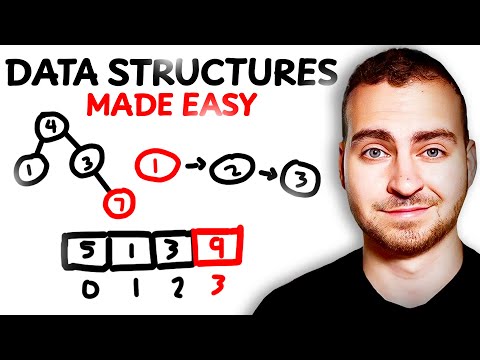
The series begins with the basics of what data structures are and why they are important. Data structures define how data is organized in memory, which directly affects how efficiently programs run. Choosing the right structure can significantly improve performance, reduce complexity, and make applications more scalable.
A key topic covered is arrays and how memory works in programming. Arrays store elements in contiguous memory locations, allowing fast access using indexes. This makes them one of the simplest and most commonly used data structures in software development.
The series also introduces linked lists, which store data in nodes connected by pointers. Unlike arrays, linked lists allow dynamic memory allocation, making it easier to insert or remove elements without reorganizing the entire structure. This makes them useful for applications where data changes frequently.
Stacks and queues are also explained as fundamental linear data structures. Stacks follow a last-in-first-out (LIFO) approach, while queues follow a first-in-first-out (FIFO) approach. These structures are widely used in programming tasks such as function calls, scheduling systems, and data buffering.
The content further explores trees as hierarchical data structures used to represent structured relationships. Trees are commonly used in databases, file systems, and search operations. They help organize data in a way that allows efficient searching and processing.
Hashing is another important topic covered in the series. Hash tables and dictionaries allow fast data retrieval using key-value pairs. This structure is widely used in caching systems, databases, and scenarios where quick lookup operations are required.
The series also introduces basic sorting and searching concepts to help learners understand how data can be organized and retrieved efficiently. These concepts form the foundation for more advanced algorithms and optimization techniques.
Throughout the series, emphasis is placed on understanding how each data structure works, when to use it, and what trade-offs it involves. This helps learners develop strong problem-solving skills and choose the most efficient solutions for different programming challenges.