Data Structure and Algorithm Patterns for Coding Interviews
عدد الدروس : 1 عدد ساعات الدورة : 01:15:03 شهادة معتمدة : نعم التسجيل في الدورة للحصول على شهادةللحصول على شهادة
- 1- التسجيل
- 2- مشاهدة الكورس كاملا
- 3- متابعة نسبة اكتمال الكورس تدريجيا
- 4- بعد الانتهاء تظهر الشهادة في الملف الشخصي الخاص بك
عن الدورة
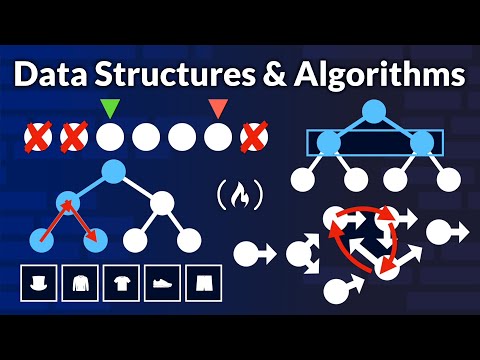
This series focuses on data structure and algorithm patterns commonly used in coding interviews, especially for solving problems on platforms like LeetCode. Instead of memorizing individual solutions, it teaches reusable problem-solving patterns that help candidates approach a wide variety of questions efficiently and confidently.
The content begins with an introduction to interview-focused problem-solving strategies. It explains how most coding interview questions are not random but follow repeatable patterns. Understanding these patterns helps developers quickly identify the right approach and reduce time spent on trial-and-error solutions.
A major focus of the series is array-based patterns, including techniques such as two pointers and sliding window. The two-pointer approach is used to solve problems involving sorted arrays or pair comparisons efficiently. Sliding window techniques help solve problems involving subarrays or substrings by maintaining a dynamic range of elements.
The series also explores recursion and backtracking patterns. Recursion is used to break problems into smaller subproblems, while backtracking helps explore all possible solutions in structured decision trees. These techniques are commonly used in problems involving permutations, combinations, and pathfinding.
Tree and graph patterns are also covered in detail. Tree traversal techniques such as depth-first search and breadth-first search help navigate hierarchical structures efficiently. Graph algorithms extend these concepts to more complex relationships, including connectivity, shortest paths, and cycle detection.
Another important topic is dynamic programming, which focuses on solving complex problems by breaking them into overlapping subproblems and storing intermediate results. This pattern is widely used in optimization problems such as sequences, knapsack variations, and path calculations.
The series also introduces hashing patterns, which are used for fast lookup and frequency counting. Hash maps are commonly used in interview problems involving duplicates, anagrams, and subarray sums.
Sorting and binary search patterns are also discussed. Sorting helps organize data for efficient processing, while binary search is used to quickly locate elements or optimize solutions in sorted or monotonic search spaces.