Create a Large Language Model from Scratch with Python – Tutorial
عدد الدروس : 1 عدد ساعات الدورة : 05:43:41 شهادة معتمدة : نعم التسجيل في الدورة للحصول على شهادةللحصول على شهادة
- 1- التسجيل
- 2- مشاهدة الكورس كاملا
- 3- متابعة نسبة اكتمال الكورس تدريجيا
- 4- بعد الانتهاء تظهر الشهادة في الملف الشخصي الخاص بك

عن الدورة
This tutorial walks through the process of building a simplified Large Language Model (LLM) from scratch using Python. It is designed to help learners understand the internal mechanics behind modern AI systems like GPT-style models by implementing core components step by step.
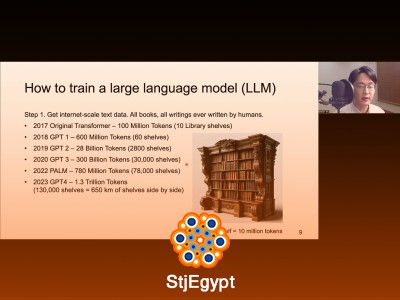
The course begins with setting up the development environment and preparing the dataset. Learners work with raw text data and learn how it must be cleaned and structured before being used for training a model.
A major focus is on tokenization, where text is broken into smaller units (tokens). The tutorial explains how token IDs are created and how these numerical representations allow neural networks to process language.
Next, the course introduces embeddings, which convert token IDs into dense vector representations. These embeddings capture semantic meaning and form the foundation for all downstream processing in the model.
The tutorial then explains the transformer architecture, focusing on self-attention mechanisms that allow the model to understand relationships between words in a sequence. Learners build simplified attention layers to see how context is computed.
Training is also covered in detail, including forward propagation, loss calculation, and backpropagation. The tutorial demonstrates how the model learns to predict the next token in a sequence using gradient-based optimization.
Finally, learners implement text generation, where the trained model produces new sequences of text based on a given prompt. This helps demonstrate how probabilistic prediction leads to coherent language output.
By the end of the tutorial, learners will unders