Electrical Engineering: Laplace Transform – Theory, s-Domain Analysis, and Applications
عدد الدروس : 58 عدد ساعات الدورة : 05:46:32 شهادة معتمدة : نعم التسجيل في الدورة للحصول على شهادةللحصول على شهادة
- 1- التسجيل
- 2- مشاهدة الكورس كاملا
- 3- متابعة نسبة اكتمال الكورس تدريجيا
- 4- بعد الانتهاء تظهر الشهادة في الملف الشخصي الخاص بك
قائمة الدروس
عن الدورة
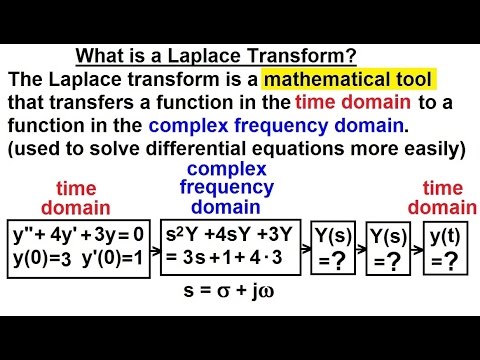
This chapter covers the Laplace Transform, a powerful mathematical tool used in electrical engineering to analyze linear time-invariant systems. It starts with the definition and mathematical formulation of the Laplace Transform and explains how to find transforms of common functions like t, e^(at), sin(wt), cos(wt), and their combinations. Learners then explore s-domain equivalents of capacitors and inductors, allowing circuit analysis in the frequency domain.
The course emphasizes the inverse Laplace Transform, including multiple strategies and the residue method, along with the linear, translation, and shifting properties. It covers Laplace Transforms of derivatives and integrals, providing methods for solving 1st and 2nd order differential equations in circuits. Advanced topics such as convolution, responses of RC, RLC, damped and undamped systems, and periodic function analysis are also included.
Through step-by-step examples, students learn to solve complex integro-differential equations, analyze system responses, and apply Laplace theory to practical engineering problems. By completing this chapter, learners gain a solid foundation for system modeling, circuit analysis, and control system design, making Laplace Transforms an essential skill for both academic studies and professional electrical engineering applications.