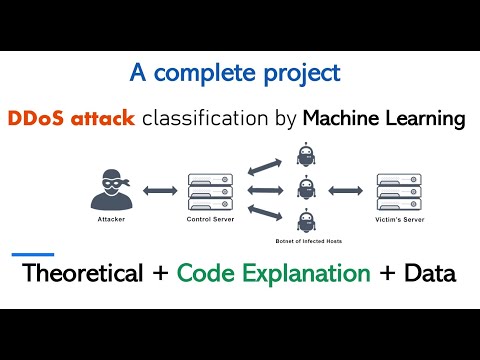
DDoS Attacks Classification Using Machine Learning – Final Year Dissertation Project
عدد الدروس : 1 عدد ساعات الدورة : شهادة معتمدة : نعم التسجيل في الدورة للحصول على شهادةللحصول على شهادة
- 1- التسجيل
- 2- مشاهدة الكورس كاملا
- 3- متابعة نسبة اكتمال الكورس تدريجيا
- 4- بعد الانتهاء تظهر الشهادة في الملف الشخصي الخاص بك
قائمة الدروس
عن الدورة
In this video, we'll dive into DDoS attack classification using Python, covering key steps from data preprocessing to model training and evaluation.
Table of Contents:
1 - Importing libraries
2 - Data Pre-processing
3 - Data Exploration
4 - Data Splitting
5 - Model Training (Random Forest, Logistic Regression, Neural Network)
6 - Model Evaluation (Accuracy, F1 Score, Recall, Precision, Confusion Matrix)
7 - Model Comparison: Area under the curve (AUC), ROC Curve graph.
The DDoS Attacks Classification by Machine Learning project is designed as a final year dissertation that focuses on detecting and categorizing distributed denial-of-service attacks using data-driven techniques. This project combines cybersecurity fundamentals with machine learning algorithms to build an intelligent threat detection system.
Students begin by understanding different types of DDoS attacks, including volumetric attacks, protocol-based attacks, and application-layer attacks. The project then moves into network traffic analysis, feature extraction, and dataset preparation. Learners work with structured traffic datasets to identify patterns that distinguish normal traffic from malicious activity.
Various machine learning models such as Logistic Regression, Decision Trees, Random Forest, Support Vector Machines (SVM), and Neural Networks may be implemented and compared to evaluate performance. The project includes training, testing, model evaluation using metrics like accuracy, precision, recall, and F1-score, and optimization techniques to improve detection rates.
By completing this dissertation project, students gain hands-on experience in cybersecurity analytics, intrusion detection systems, and applied machine learning. The final outcome is a functional DDoS classification model capable of identifying attack types in real-time or simulated environments.