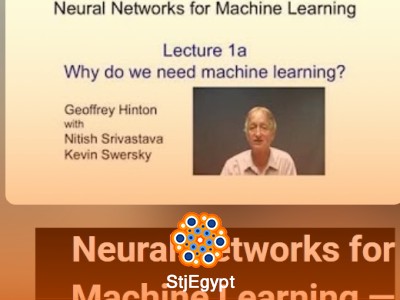

This lecture series by Geoffrey Hinton from the University of Toronto introduces the fundamental concepts of deep learning and neural networks. It is designed to help learners understand why machine learning is necessary and how neural systems can be used to model intelligent behavior.
The course begins by explaining why we need machine learning in modern AI systems and how traditional programming differs from learning-based approaches. It then introduces neural networks and simple models of neurons, showing how biological inspiration leads to computational models.
Learners explore different types of learning, including supervised, unsupervised, and reinforcement learning, along with how these approaches are used in artificial intelligence systems. The lectures also explain different neural network architectures and the historical development of perceptrons, which are the earliest forms of neural networks.
A key part of the course is understanding why learning works, including geometric interpretations of perceptrons and how decision boundaries are formed. It also discusses limitations of neural networks and what types of problems they cannot solve effectively.
By the end of this series, learners gain a strong theoretical foundation in deep learning concepts, preparing them for more advanced topics such as backpropagation, deep architectures, and modern AI systems used today in industry and research.