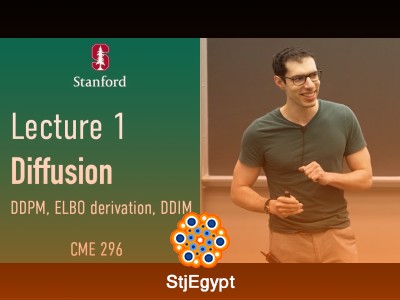

This Stanford course on Diffusion and Large Vision Models is an advanced university-level series focused on modern generative AI systems, diffusion models, and large-scale visual learning architectures. The lectures provide deep theoretical and practical insights into how cutting-edge AI image generation systems work.
The course begins with the fundamentals of diffusion models, explaining how generative systems gradually learn to remove noise from data to generate realistic images and visual outputs. Learners gain an understanding of the mathematical intuition behind diffusion-based AI generation.
A major focus is on score matching and flow matching techniques, which are key training concepts used in modern generative modeling. These methods help AI systems learn probability distributions and generate high-quality outputs efficiently.
The course also explores latent space representations and guidance techniques, helping learners understand how models compress, manipulate, and generate visual information in hidden feature spaces.
Advanced lectures cover large vision model architectures and training strategies used in state-of-the-art AI systems. Students learn about scalable neural network design, optimization, and model training pipelines.
In addition, the course connects diffusion systems with transformers and large language models (LLMs), highlighting modern trends in multimodal AI research and generative technologies.
This training is ideal for learners interested in machine learning research, computer vision, deep learning, and generative AI development.
By the end of the course, learners