Electrical Engineering: Fourier Series – Theory, Amplitude-Phase, and Practical Applications
عدد الدروس : 16 عدد ساعات الدورة : 01:35:26 شهادة معتمدة : نعم التسجيل في الدورة للحصول على شهادةللحصول على شهادة
- 1- التسجيل
- 2- مشاهدة الكورس كاملا
- 3- متابعة نسبة اكتمال الكورس تدريجيا
- 4- بعد الانتهاء تظهر الشهادة في الملف الشخصي الخاص بك
قائمة الدروس
عن الدورة
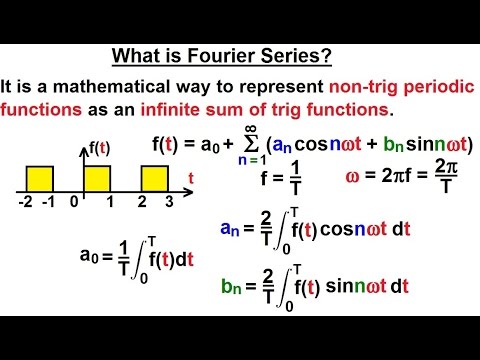
This chapter introduces the Fourier Series, a fundamental tool in electrical engineering for representing periodic signals as a sum of sines and cosines. The course begins by explaining what a Fourier Series is, why it is needed, and the important integrals involved. Students learn to compute the coefficients a₀, aₙ, and bₙ and summarize methods for constructing the complete Fourier Series.
The chapter covers practical examples, including sawtooth and triangular waves, and shows how to apply the Dirichlet conditions to determine the validity of a series representation. It also introduces the amplitude-phase form, which simplifies signal analysis in real-world circuits. Learners are taught to graph the Fourier Series, and analyze even and odd periodic functions, which reduces computation and enhances understanding.
By combining theory with worked examples, this chapter equips learners to model complex periodic signals, analyze their frequency components, and apply Fourier Series techniques in signal processing, circuit analysis, and communications. Completing this module provides the tools to transition from time-domain signal representation to frequency-domain analysis, a critical skill for electrical engineers dealing with AC circuits, filters, and waveform synthesis.