Fundamentals of Robotics – Theory and Applications
عدد الدروس : 21 عدد ساعات الدورة : 06:02:13 شهادة معتمدة : نعم التسجيل في الدورة للحصول على شهادةللحصول على شهادة
- 1- التسجيل
- 2- مشاهدة الكورس كاملا
- 3- متابعة نسبة اكتمال الكورس تدريجيا
- 4- بعد الانتهاء تظهر الشهادة في الملف الشخصي الخاص بك
قائمة الدروس
عن الدورة
This comprehensive robotics course introduces the foundational concepts required to understand and design robotic systems. Starting with the basics, you’ll explore robot configurations, degrees of freedom, workspace, and task space. The course explains holonomic and nonholonomic constraints and how they affect robot motion.
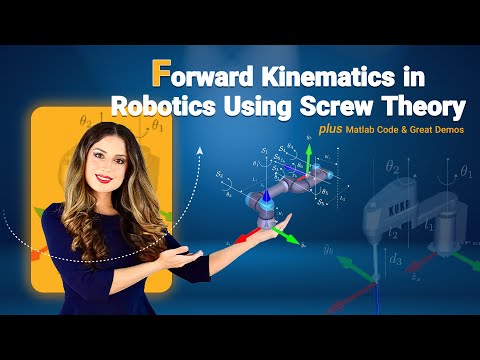
You’ll dive into kinematics, including forward and inverse kinematics, using screw theory and twists to model and analyze robot motions. Transformation techniques such as rotation matrices, exponential coordinates, and homogeneous transformation matrices are covered, alongside Euler angles, roll-pitch-yaw representations, and quaternions.
The course emphasizes practical applications with MATLAB demonstrations, allowing you to simulate robot motions, understand angular velocities, and visualize the effect of various parameters. Screw motion and exponential coordinates provide a geometric understanding of robot movements, while wrenches and forces explain interactions with the environment.
By the end of this course, you’ll have a solid grasp of the theoretical and computational tools in robotics, preparing you for advanced topics like robot dynamics, control, and automation systems. Ideal for engineering students, robotics enthusiasts, and anyone looking to build a strong foundation in modern robotics.