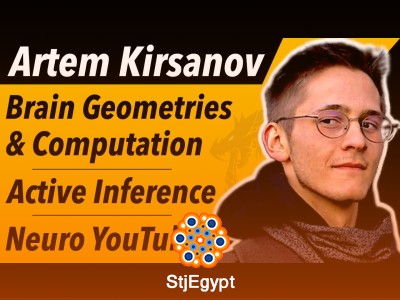

This course introduces the exciting field of computational neuroscience, where mathematics, physics, and biology combine to explain how the brain processes information. Through engaging visual explanations, learners explore how complex brain activity can be understood using geometry, dynamical systems, and mathematical patterns.
The course begins with an exploration of abstract spaces and neural manifolds, which are mathematical structures used to describe patterns of neural activity in the brain. These concepts help researchers understand how groups of neurons encode behavior, perception, and decision-making.
Students will also learn about memory consolidation, the process by which the brain transforms short-term experiences into long-term memories. The course explains how neural networks reorganize information during sleep and rest to strengthen memory storage.
Another fascinating topic covered is the geometric structure of brain activity, including how neural signals may move through curved mathematical spaces such as toroidal structures. Learners will also explore the logarithmic nature of brain perception, explaining why the brain processes sensory information in nonlinear ways.
The course concludes with an introduction to theta rhythms, an important brain wave pattern associated with learning, navigation, and memory formation. Together, these concepts provide a deeper understanding of how the brain organizes informa