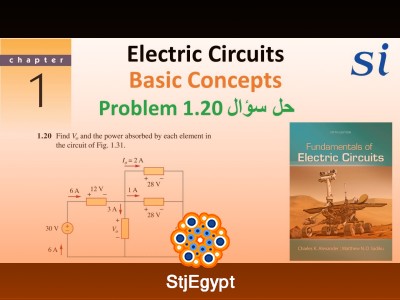

Fundamentals of Electric Circuits introduces learners to the essential principles of electrical engineering and circuit analysis. The course begins with basic concepts such as voltage, current, resistance, and Ohm’s Law, providing a solid foundation for understanding how circuits operate. It then progressively covers more advanced topics, including series and parallel circuits, Kirchhoff’s Laws, network theorems, and Thevenin and Norton equivalents, helping students simplify complex networks efficiently.
Each chapter includes detailed explanations of key concepts, step-by-step problem-solving strategies, and practical examples that illustrate real-world applications of circuit theory. The course also covers both AC and DC circuits, providing insight into alternating current behavior, phasors, impedance, and power calculations. Learners will also explore capacitors, inductors, and reactive components, gaining a deeper understanding of their roles in circuits.
By the end of this course, students will be confident in analyzing and solving electrical circuits, understanding both theoretical principles and practical applications. This course is ideal for electrical engineering students, hobbyists, and anyone seeking a complete understanding of electric circuits from fundamentals to advanced problem-solving techniques.